

 Sign in
 Rose Catalog
William Baffin, hybrid kordesii
Share
Prices nearby
or to see prices for this rose



















Brief summary
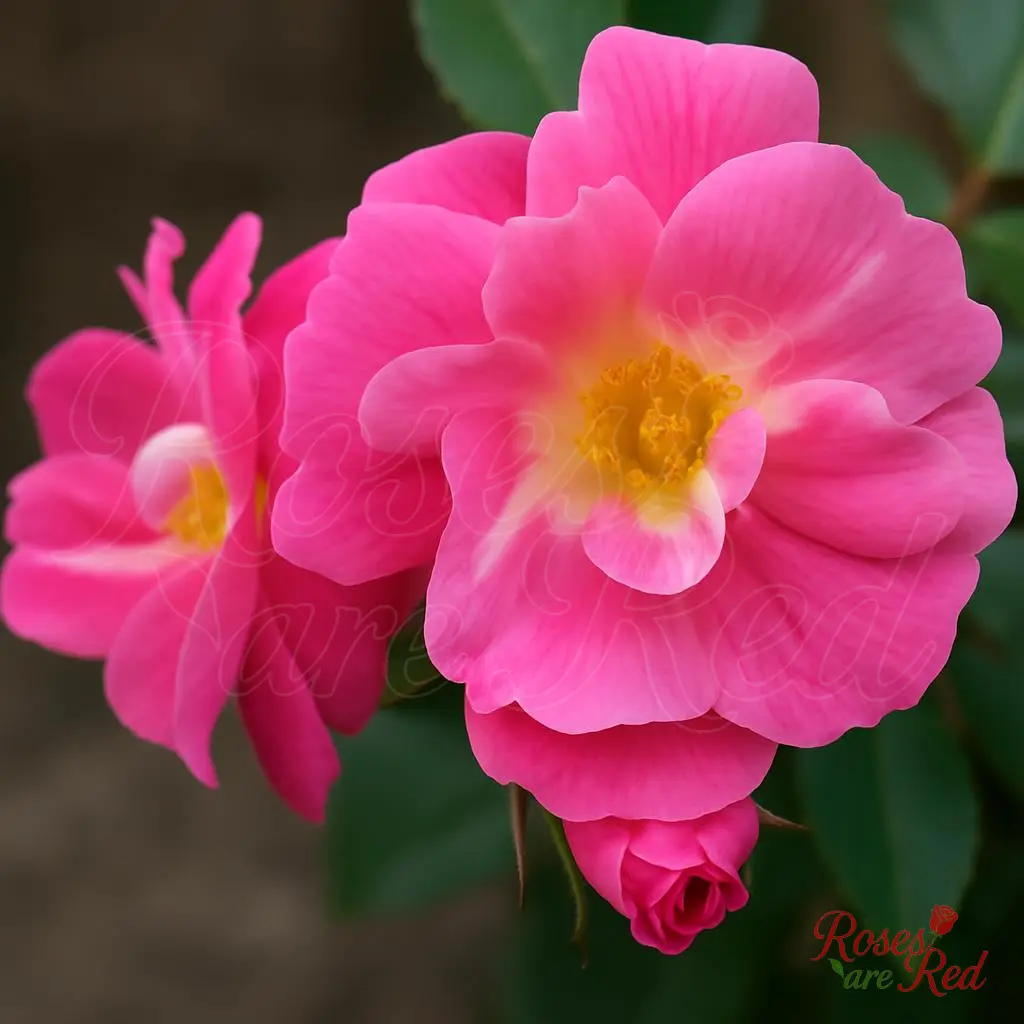
Modern Rose, hybrid kordesii "William Baffin", introduced by Dr. Felicitas Svejda in 1983, Usually is pink in color, semi double bloom shape, blooms 6 - 7 cm in size, has 5-10 buds per stem, continual rebloom, has light fragrance, the bush shape can be arching, 180 - 200 cm in height, 200 cm in width, suitable for USDA zone 3 from -40°C and above, low resistance to rain, strong resistance to black spot, strong resistance to mildew.
Main characteristics

Aroma

USDA Zone 3
-40°С

Rebloom


Bush Shape

Bloom Shape
Semi double
Size

Height
180 - 200 cm

Width
200 cm
Bloom size
6 - 7 cm
Buds / Stem
5-10

Petal Count
Resistance

Heat

Shade

Rain

Black Spot
Mildew
More information
William Baffin is a very vigorous, robust, and winter-hardy rose in the Explorer series. The semi-double blooms are bright pink, with golden stamens, a white spot at the base of the petals, and a paler reverse (especially noticeable when the petals curl toward the centre). They appear in large clusters of 10–30 flowers, more or less continuously through summer and autumn. In full bloom, the shrub resembles a species rose. The foliage is dark, glossy, and disease-resistant. It responds well to fertilization and is readily propagated from cuttings.
This variety is reported as the strongest in the series, reaching 3 m or more in height. The semi-double flowers (about 7 cm across) are deep pink, with a white spot in the centre and a paler reverse. The petals curve, creating a colour contrast between the outer and inner surfaces. They form clusters of 10–25 flowers, and the shrub flowers more or less continuously throughout summer and autumn. No fragrance. The foliage is dense, shiny, and quite disease-resistant.
The shrub is upright with slightly arching shoots, dense and well shaped, suitable for hedges. Trained as a climber, it requires restraint to prevent overgrowth of the trellis. The variety is very winter-hardy; no frozen branches were observed during the cultivation period, it shows disease resistance, and it is easily propagated from cuttings. The semi-double blooms appear in clusters all summer.
This variety is reported as the strongest in the series, reaching 3 m or more in height. The semi-double flowers (about 7 cm across) are deep pink, with a white spot in the centre and a paler reverse. The petals curve, creating a colour contrast between the outer and inner surfaces. They form clusters of 10–25 flowers, and the shrub flowers more or less continuously throughout summer and autumn. No fragrance. The foliage is dense, shiny, and quite disease-resistant.
The shrub is upright with slightly arching shoots, dense and well shaped, suitable for hedges. Trained as a climber, it requires restraint to prevent overgrowth of the trellis. The variety is very winter-hardy; no frozen branches were observed during the cultivation period, it shows disease resistance, and it is easily propagated from cuttings. The semi-double blooms appear in clusters all summer.
Popular Breeders
Articles