


 Sign in
 Rose Catalog
Sea Foam, shrub
Also known as
Seafoam
Share
Prices nearby
or to see prices for this rose



















Brief summary
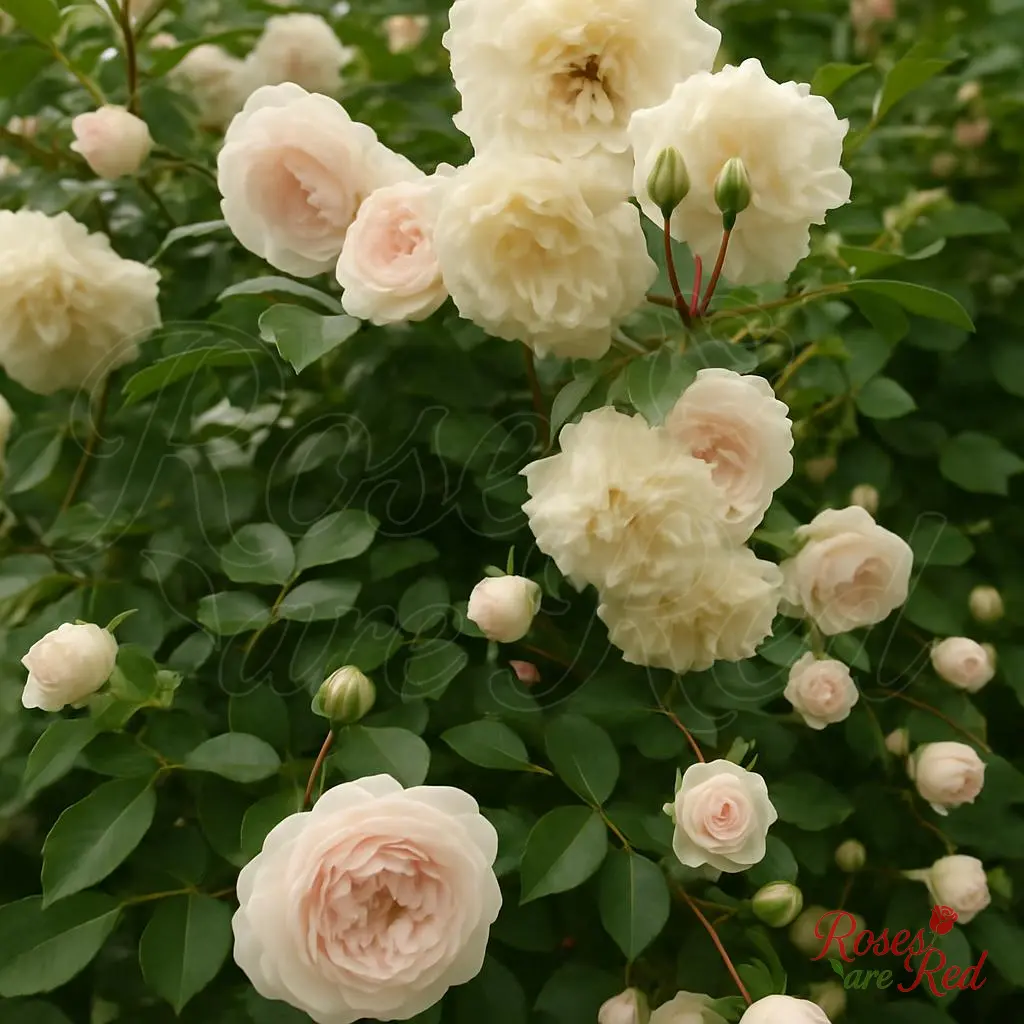
Modern Rose, shrub "Sea Foam", introduced in 1963, Usually is white in color, flat bloom shape, blooms 4 - 5 cm in size, has 5-10 buds per stem, continual rebloom, has light fragrance, the bush shape can be arching, 80 - 100 cm in height, 200 cm in width, suitable for USDA zone 5 from -29°C and above, low resistance to rain, moderate resistance to black spot, moderate resistance to mildew.
Main characteristics

Aroma

USDA Zone 5
-29°С

Rebloom


Bush Shape

Bloom Shape
Flat
Size

Height
80 - 100 cm

Width
200 cm

Bloom size
4 - 5 cm

Buds / Stem
5-10

Petal Count
Resistance

Heat

Shade

Rain

Black Spot

Mildew
More information
The classification of Sea Foam has long been debated. It is most practically treated as a crabapple, manageable as a groundcover rose or a low climber. The flowers are white, with a pink, pearly tint at the center that fades quickly. They have an old-fashioned, densely filled form. The flowers perform best in hot, dry weather, although they are larger in cool, humid climates. This variety starts late, then blooms continuously until late autumn. Sea Foam has long, drooping shoots that reach only 1 m in cold climates but up to 3 m in hot conditions. It suits a clumped, weeping habit. The foliage is fine, dark green, and disease resistant; the shrub is very prickly. Propagates readily from cuttings.
A landscape rose suitable for a low hedge, as a groundcover rose, or to cascade on a slope. Can also be used as a low climbing rose. Grows well in semi-shade. Small creamy-white flowers appear in clusters on long arching shoots. Very prickly.
The flowers are cream or white, appearing in small clusters. The foliage is small, shiny, dark green. The bush is strong, with long semi-arching shoots. It is usually grown as a groundcover rose, as the length of the shoots is not enough for growing as a pliant rose (they rarely exceed 1 m), but the variety forms a weeping clump. The flowers are rain-sensitive, so it is best grown in dry climates.
A landscape rose suitable for a low hedge, as a groundcover rose, or to cascade on a slope. Can also be used as a low climbing rose. Grows well in semi-shade. Small creamy-white flowers appear in clusters on long arching shoots. Very prickly.
The flowers are cream or white, appearing in small clusters. The foliage is small, shiny, dark green. The bush is strong, with long semi-arching shoots. It is usually grown as a groundcover rose, as the length of the shoots is not enough for growing as a pliant rose (they rarely exceed 1 m), but the variety forms a weeping clump. The flowers are rain-sensitive, so it is best grown in dry climates.
Popular Breeders
Articles