

 Sign in
 Rose Catalog
Rosa X hemisphaerica, shrub

Prices nearby


















Brief summary
Main characteristics





Size


Resistance




More information
Medium yellow rose species, bred by an unknown breeder prior to 1516 and discovered by Charles de L'Écluse in the Netherlands in 1601. It was introduced in the United Kingdom by Nicholas Leat before 1629 under the name 'Double Yellow'. This species is a wild or species cross type.
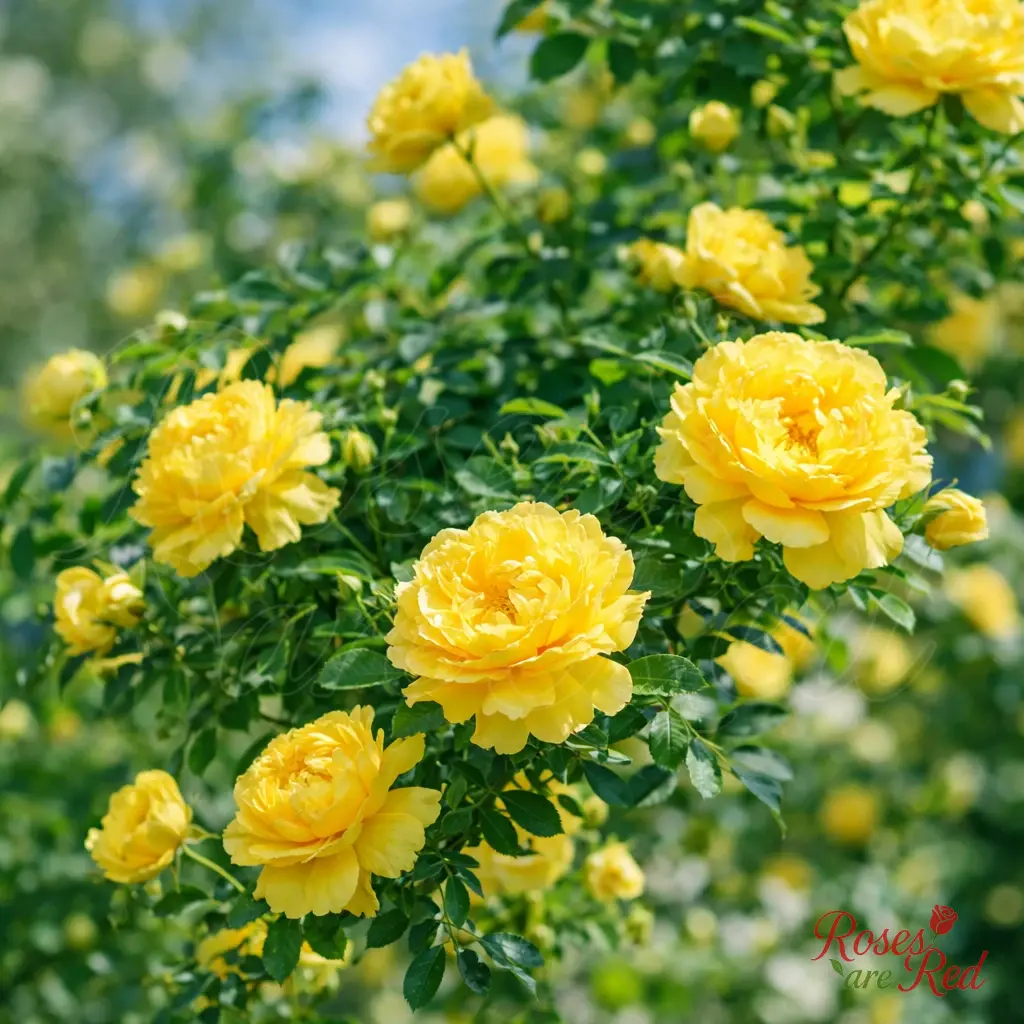
The rose has yellow blooms with none to mild fragrance and an average diameter of 1.5 inches. The blooms can be small and large, single with 4 to 8 petals, and very double. Blooms are mostly solitary with a button-eye and globular form, flowering once in spring or summer.
The plant is upright and well-branched with small, dark green foliage consisting of 5 to 9 leaflets. It reaches a height of 47 inches to 6 feet (120 to 185 cm) and a width of up to 4 feet (up to 120 cm). Suitable for USDA zones 6b through 9b, the plant is drought-resistant, prefers dry climates, and its blooms tend to ball in wet weather.
The patent status is unknown. The rose is a tetraploid hybrid of Rosa hemisphaerica var. rapinii Rowley. It may be synonymous with 'Sulfureux' by Ducher, and Robert Buist considered R. lutea and R. sulphurea as identical. Referenced by the Botanical Register, its date is based on the inclusion of the illustration in the Hortus Eystettensis, published in 1613. See the photo uploaded on February 15, 2009.
Scientific reference: Rosa bungeana Boiss. & Buhse, Nouv. Mém. Soc. Imp. Naturalistes Moscou 12: 84. 1860.