


 Sign in
 Rose Catalog
Share
Prices nearby
or to see prices for this rose



















Brief summary
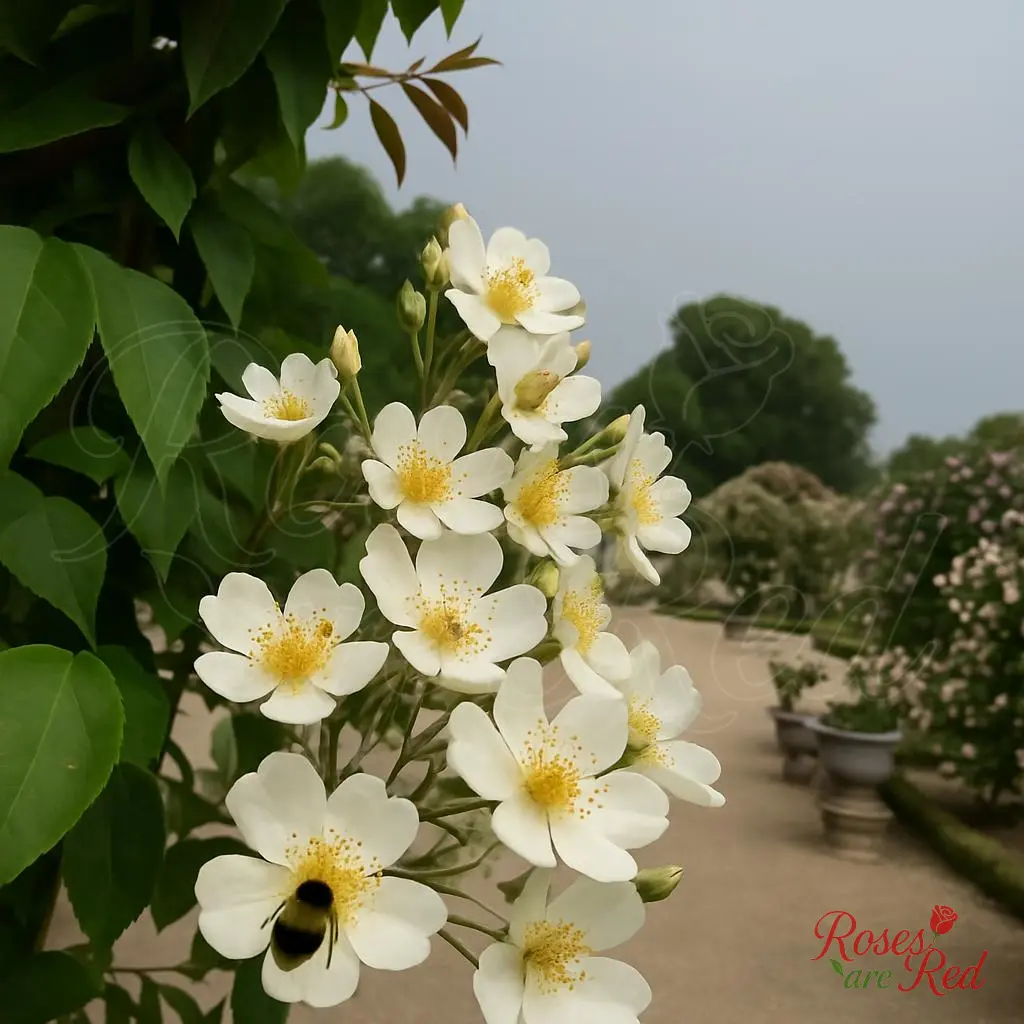
Modern Rose, species "Kiftsgate", United Kingdom, introduced by Murrell in 1954, Usually is white, yellow in color, flat bloom shape, single count petal count, blooms 3 - 4 cm in size, has 5-10 buds per stem, once rebloom, has moderate fragrance, the bush shape can be climbing, 500 - 1200 cm in height, 400 - 2700 cm in width, suitable for USDA zone 6 from -23°C and above, moderate resistance to shade, moderate resistance to rain, moderate resistance to black spot, moderate resistance to mildew.
Main characteristics

Aroma

USDA Zone 6
-23°С

Rebloom


Bush Shape

Bloom Shape
Flat
Size

Height
500 - 1200 cm

Width
400 - 2700 cm

Bloom size
3 - 4 cm

Buds / Stem
5-10

Petal Count
Single count
Resistance

Heat

Shade

Rain

Black Spot

Mildew
More information
Kiftsgate is regarded as a form of the Chinese species Rosa filipes. It is named after Kiftsgate, a garden in Gloucestershire, UK, where it first appeared as a chance seedling. The original plant has reached 25 m, growing over an old beech tree, and is possibly the largest rose in Europe. The blooms are small, single, white, produced in very large clusters of up to 100 per truss, followed by similarly large clusters of small orange hips. The flowers have bright golden stamens and long, slender petals. The foliage is pale green, bronze when young, and large. The rose roots readily and also hybridizes easily, so several roses under this name are in cultivation. Because it is very large and not suitable for small gardens, it is generally planted in large gardens.
This seedling of the wild Rosa filipes from western China grows to very large size. When trained against a wall, it can extend to 7 metres in three years, with a recorded length of 45 metres. It can completely encircle a large tree. The shoots are prickly, with recurved thorns, which makes pruning laborious. It is therefore commonly grown as a freestanding shrub; in that case it forms a bush about 4 metres in height and width. In mid-summer, dense trusses of single creamy flowers with fragrance appear, followed by hips. Unripe hips are orange; mature hips are bright red.
The flowers are white, with bright yellow stamens, up to 2.5 cm in diameter. They tolerate rain well and remain intact until they drop. An individual flower is faintly scented, but a flowering plant scents the surrounding air with notes of vanilla and banana. The flowers are borne in large clusters of over 100 buds. This rose starts blooming later than usual, opening when other varieties are already in their first wave, and the display lasts for several weeks. It is a very vigorous grower. The plant can reach 10 metres in height and 7.5 metres in width. Growth can be restrained somewhat, but it should not be placed in a small area, as it needs ample space. The long stems are very flexible and their growth is easy to direct. The variety shows high disease resistance.
Rosa filipes is a large shrub, reaching 10 metres in height, with arching, drooping shoots armed with thorns about 1 cm long. Young foliage is smooth and copper-red. The flowers are musk-scented, about 2.5 cm in diameter, and appear in huge shield-shaped (corymb) inflorescences, sometimes 100 per inflorescence, with trusses reaching 40 to 50 cm in diameter. The petals are elongated and rarely overlap, giving an airy appearance. The fruits are usually rounded, about 1 cm in diameter, orange or scarlet, and borne in large clusters. Rosa filipes is native to western China. This species is among the last to bloom, later than other roses, and is less shade tolerant than other Asian species. It is presently represented exclusively by the Kiftsgate clone, which appeared in the garden of Kiftsgate Court.
This seedling of the wild Rosa filipes from western China grows to very large size. When trained against a wall, it can extend to 7 metres in three years, with a recorded length of 45 metres. It can completely encircle a large tree. The shoots are prickly, with recurved thorns, which makes pruning laborious. It is therefore commonly grown as a freestanding shrub; in that case it forms a bush about 4 metres in height and width. In mid-summer, dense trusses of single creamy flowers with fragrance appear, followed by hips. Unripe hips are orange; mature hips are bright red.
The flowers are white, with bright yellow stamens, up to 2.5 cm in diameter. They tolerate rain well and remain intact until they drop. An individual flower is faintly scented, but a flowering plant scents the surrounding air with notes of vanilla and banana. The flowers are borne in large clusters of over 100 buds. This rose starts blooming later than usual, opening when other varieties are already in their first wave, and the display lasts for several weeks. It is a very vigorous grower. The plant can reach 10 metres in height and 7.5 metres in width. Growth can be restrained somewhat, but it should not be placed in a small area, as it needs ample space. The long stems are very flexible and their growth is easy to direct. The variety shows high disease resistance.
Rosa filipes is a large shrub, reaching 10 metres in height, with arching, drooping shoots armed with thorns about 1 cm long. Young foliage is smooth and copper-red. The flowers are musk-scented, about 2.5 cm in diameter, and appear in huge shield-shaped (corymb) inflorescences, sometimes 100 per inflorescence, with trusses reaching 40 to 50 cm in diameter. The petals are elongated and rarely overlap, giving an airy appearance. The fruits are usually rounded, about 1 cm in diameter, orange or scarlet, and borne in large clusters. Rosa filipes is native to western China. This species is among the last to bloom, later than other roses, and is less shade tolerant than other Asian species. It is presently represented exclusively by the Kiftsgate clone, which appeared in the garden of Kiftsgate Court.
Popular Breeders
Articles