

 Sign in
 Rose Catalog
Share
Prices nearby
or to see prices for this rose


















Brief summary
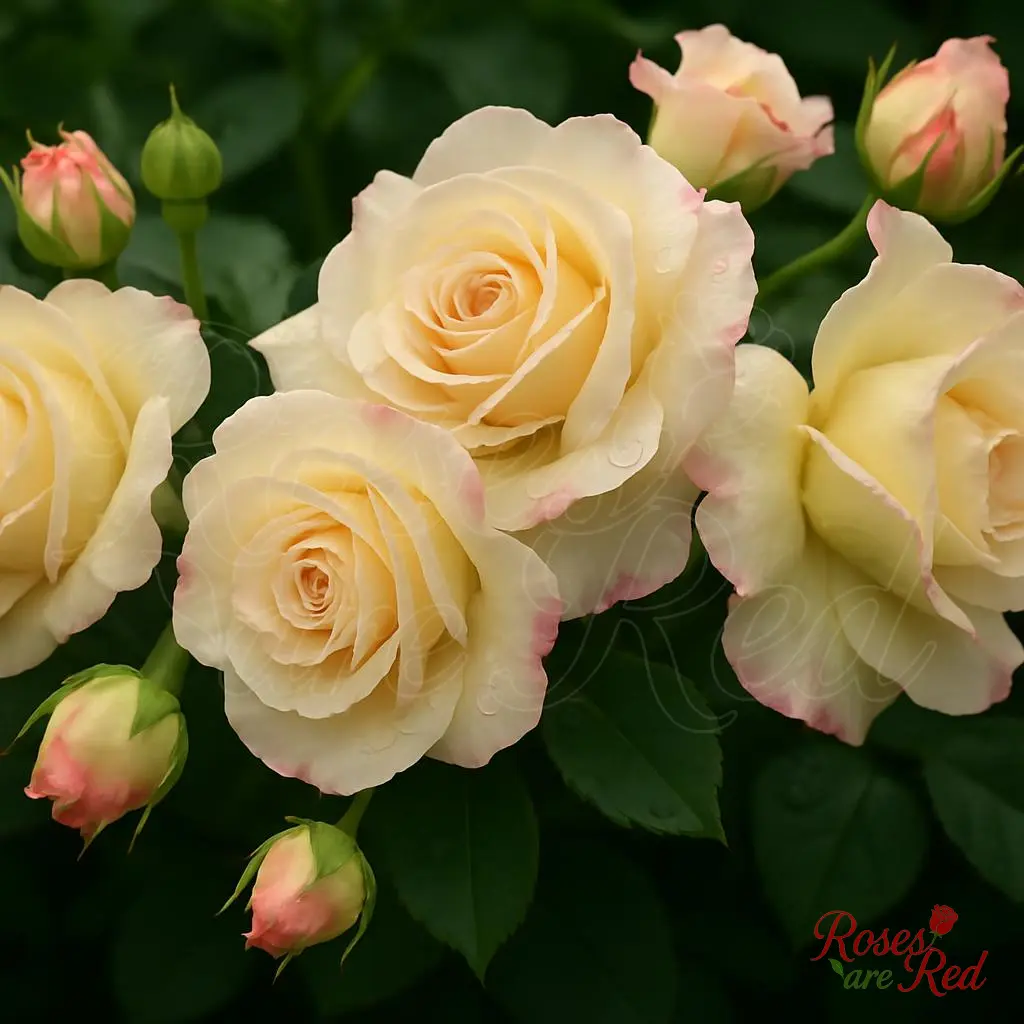
Modern Rose, floribunda "Galaxy", France, introduced by Meilland Roses in 1995, Usually is ivory in color, globular bloom shape, blooms 7 - 8 cm in size, has 3-5 buds per stem, repeat rebloom, has moderate fragrance, the bush shape can be bushy, 80 - 100 cm in height, 75 cm in width, suitable for USDA zone 6 from -23°C and above, low resistance to rain, strong resistance to black spot, strong resistance to mildew.
Main characteristics

Aroma

USDA Zone 6
-23°С

Rebloom


Bush Shape

Bloom Shape
Globular
Size

Height
80 - 100 cm

Width
75 cm
Bloom size
7 - 8 cm
Buds / Stem
3-5

Petal Count
Resistance

Heat

Shade

Rain

Black Spot
Mildew
More information
Galaxy is a free-flowering creamy pink floribunda. Buds are creamy yellow with red tips; they open into rounded, creamy-yellow blooms whose edges fade to white while the centers retain a light yellow or cream hue. The color shifts with the season—paler in summer and more pink in autumn—while the tones remain light. Flowers are borne in tight clusters of 3–9, sometimes more. Foliage is small and disease-resistant; the bush is upright. In hot climates it reaches 1.5 m.
This floribunda shows a shrub-like growth habit. It spreads more than it rises and is well branched. In summer it carries clusters of double flowers about 5 cm in diameter. Flower color is cream or pale yellow with a pinkish tint.
Buds of ochre-yellow with a reddish edge open to creamy-yellow flowers with a slight reddish bloom along the petal margins. Bushes are dense and spreading, with large, thick leaves that show a light bronze tint when young. The rose has a spicy scent reminiscent of linseed oil. A varietal peculiarity, also seen in some vigorous cultivars from various garden groups, is noted: in a cold, prolonged spring, a bundle of 3–4 buds may form instead of a single bud. If all but the strongest are not removed in time, the bush becomes disordered and full bloom can be lost.
This floribunda shows a shrub-like growth habit. It spreads more than it rises and is well branched. In summer it carries clusters of double flowers about 5 cm in diameter. Flower color is cream or pale yellow with a pinkish tint.
Buds of ochre-yellow with a reddish edge open to creamy-yellow flowers with a slight reddish bloom along the petal margins. Bushes are dense and spreading, with large, thick leaves that show a light bronze tint when young. The rose has a spicy scent reminiscent of linseed oil. A varietal peculiarity, also seen in some vigorous cultivars from various garden groups, is noted: in a cold, prolonged spring, a bundle of 3–4 buds may form instead of a single bud. If all but the strongest are not removed in time, the bush becomes disordered and full bloom can be lost.
Popular Breeders
Articles