

 Sign in
 Rose Catalog
American Pillar, hybrid wichurana
Share
Prices nearby
or to see prices for this rose



















Brief summary
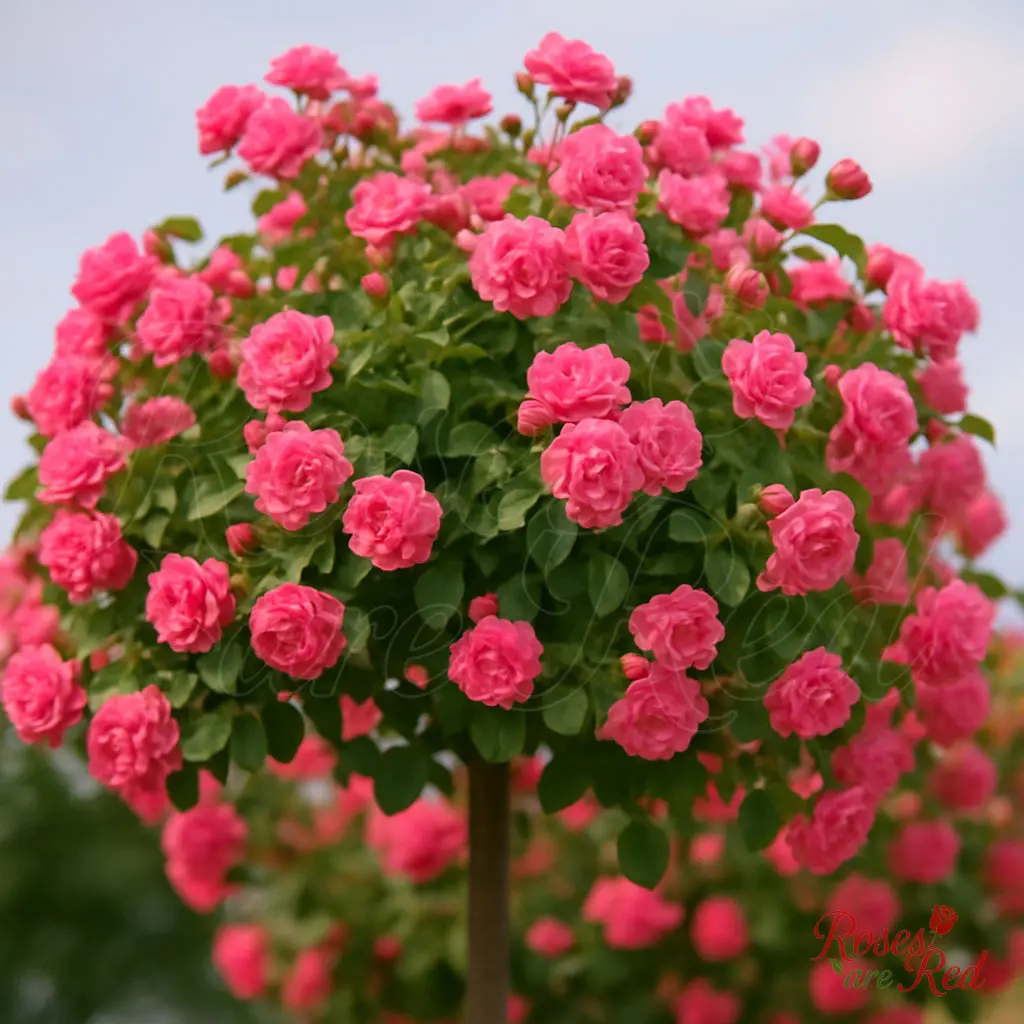
Modern Rose, hybrid wichurana "American Pillar", introduced in 1902, Usually is crimson in color, flat bloom shape, blooms 5 - 6 cm in size, has 5-10 buds per stem, once rebloom, has light fragrance, the bush shape can be arching, 300 - 400 cm in height, 200 cm in width, suitable for USDA zone 5 from -29°C and above, moderate resistance to rain, moderate resistance to black spot, moderate resistance to mildew.
Main characteristics

Aroma

USDA Zone 5
-29°С

Rebloom


Bush Shape

Bloom Shape
Flat
Size

Height
300 - 400 cm

Width
200 cm
Bloom size
5 - 6 cm

Buds / Stem
5-10

Petal Count
Resistance

Heat

Shade

Rain

Black Spot

Mildew
More information
American Pillar has been widely grown since its introduction. It flowers very abundantly, but relatively late, when many other roses have passed peak bloom. It propagates readily by cuttings, is straightforward to grow, and is the hardiest of the Van Fleet roses. The flowers are bright crimson with a distinct white center and a large cluster of golden stamens; in hot weather and strong sun the color becomes paler. It grows and blooms across climates ranging from very hot to very cold. Flowers appear in large clusters and are followed by scarlet spikes. The shrub is very vigorous, producing many thin shoots covered with large thorns. The foliage turns slightly bronze in early autumn and remains on the plant for a long period.
Flowers are borne in trusses of 5–20 in very large numbers. They are bright crimson with a white center and bright golden stamens; in heat the color is paler. The foliage is large, glossy, and disease-resistant. Shoots are fairly stiff, upright, bare at the base, and are best trained horizontally. They reach 3–4 m; after 3–4 years the older shoots begin to die back. Very easy to root from cuttings.
Buds are globular. Flowers are carmine-pink with a white eye, saucer-shaped, open, large (4–5 cm), single, in large inflorescences of up to 20, on long, slender pedicels. Leaves are leathery, shiny, rounded. Spines are large, hook-shaped, with a broad base. Shrubs are very strong (up to 5 m). Flowering is abundant, lasting 35–40 days. Winter-hardy. Sensitive to powdery mildew.
Shade-tolerant variety.
Flowers are borne in trusses of 5–20 in very large numbers. They are bright crimson with a white center and bright golden stamens; in heat the color is paler. The foliage is large, glossy, and disease-resistant. Shoots are fairly stiff, upright, bare at the base, and are best trained horizontally. They reach 3–4 m; after 3–4 years the older shoots begin to die back. Very easy to root from cuttings.
Buds are globular. Flowers are carmine-pink with a white eye, saucer-shaped, open, large (4–5 cm), single, in large inflorescences of up to 20, on long, slender pedicels. Leaves are leathery, shiny, rounded. Spines are large, hook-shaped, with a broad base. Shrubs are very strong (up to 5 m). Flowering is abundant, lasting 35–40 days. Winter-hardy. Sensitive to powdery mildew.
Shade-tolerant variety.
Popular Breeders
Articles